Your aligner refinement
planning checklist.
A practical organizer for appointments, written inclusions and delivery details. Download a copy to take to your next discussion.
- 01
Keep the reference
Record your provider, current tray-series identifier and the date of the proposed review.
- 02
Confirm the next appointment
Note the contact route and appointment or check-in date supplied by your provider.
- 03
Organize requested records
List the photographs, scans or other records your provider has requested and how to submit them.
- 04
Check the written fee
Ask whether the additional series is included, what the allowance covers and when it expires.
- 05
Confirm delivery details
Record the quoted production and delivery estimate, plus any shipping or replacement charges.
- 06
Keep the follow-up plan
Save the written monitoring arrangements and who to contact about fit or delivery questions.
- 07
Ask about retainers
Check whether the final retainers are included and how replacements are priced.
What counts as a refinement?
Providers may use terms such as additional aligners, finishing trays, mid-course correction, or refinement. Definitions are not perfectly standardized. In practice, the clinician reassesses teeth and bite, collects updated records, and designs another sequence to address remaining movements.
A refinement should have a specific objective: improving a rotation, closing residual space, coordinating arches, correcting tracking, or finishing contacts. More trays without a documented goal is not a meaningful explanation.
Why planned and achieved movement can differ
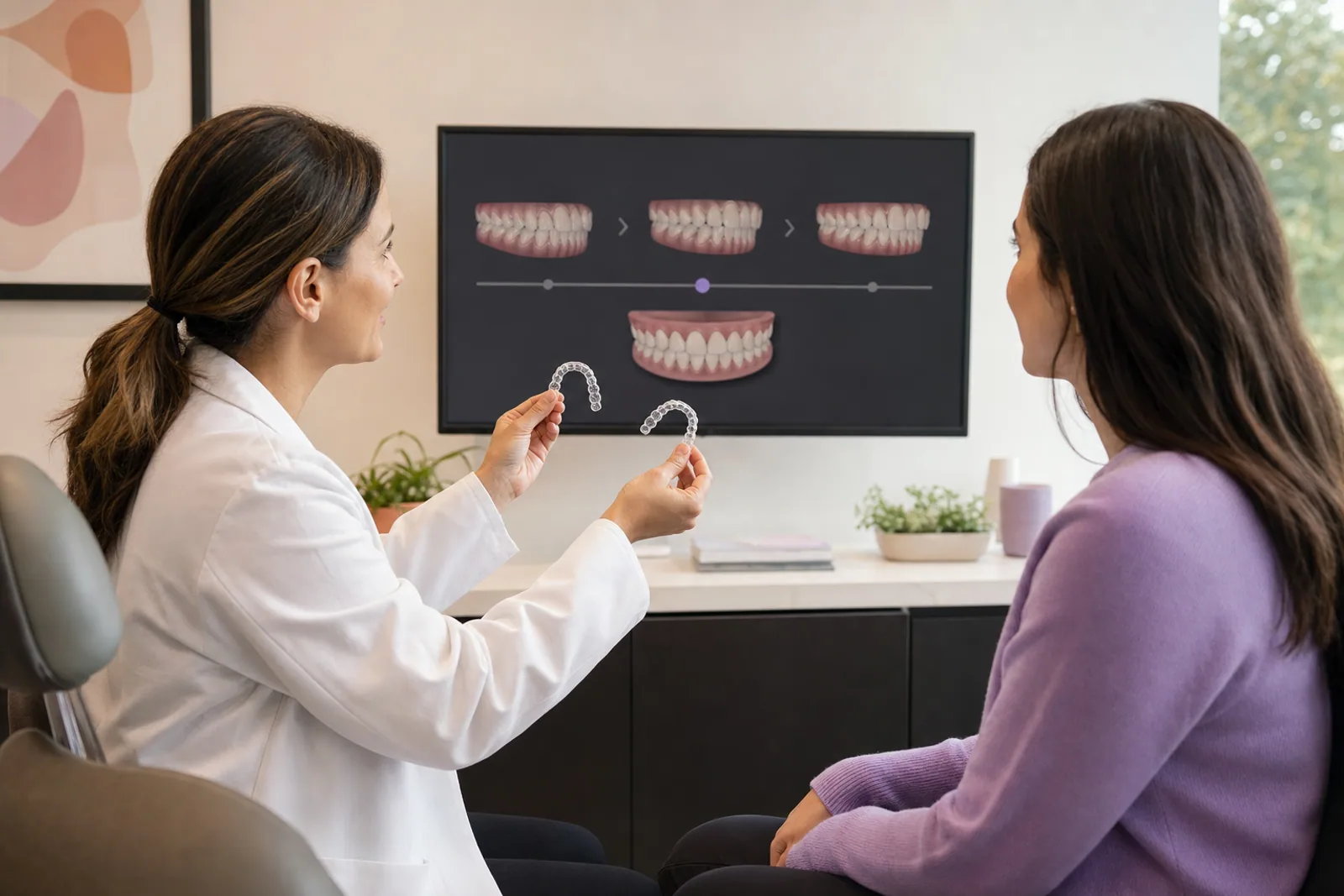
A digital preview is a treatment plan, not a biological guarantee. Teeth respond through living bone and tissues. Wear time, tray fit, attachment condition, movement type, case complexity, and individual biology affect what happens.
Recent evidence describes refinements as multifactorial. Rotations, intrusion, vertical correction, expansion, extraction space closure, and longer sequences may be less predictable in some circumstances. That makes monitoring and contingency planning important.
What should be checked before more trays?
The clinician should compare current positions with the plan, evaluate the bite, check attachments, review wear and tray history, and look for oral-health problems. New scans or impressions and photographs may be collected. An in-person exam or radiograph may be needed if symptoms or roots cannot be evaluated remotely.
If trays stopped fitting because wear was inconsistent, the solution may differ from a biologic movement limitation. Honest wear information helps the team choose a safer reset point.
How refinements affect time and cost
New records, design, manufacturing, and shipping add time. The number of trays depends on remaining objectives, not a standard package. Ask whether the estimated treatment length includes a finishing phase or only the first series.
Before purchase, confirm how many refinement rounds are included, what qualifies, whether new scans or attachments cost extra, and what happens if refinement is clinically inappropriate. Unlimited trays is less useful than clear supervision and completion criteria.
How to improve the next phase
Start the new series with a fit check and written schedule. Protect attachments, keep the previous tray, and report visible gaps early. Do not jump forward because the next tray feels easier. If elastics or IPR are added, ask how they change the objective.
Use the tracking guide to document fit. Extra trays do not pause cavity or gum risks, so regular cleaning and dental care continue.
How do you know treatment is finished?
Completion is not just the last tray fitting. The clinician should assess alignment, bite contacts, remaining spaces, gum health, and whether the result matches realistic goals. Some differences may be accepted because further movement would add risk without meaningful benefit.
Once movement ends, retention begins. Confirm attachment removal, final records, retainer delivery, wear schedule, and replacement policy. Teeth can shift while waiting for retainers.
Practical planning checklist
When a refinement is proposed, ask the clinician to show which movements match the plan and which do not. A side-by-side scan or photograph can make the reason concrete. The updated objective might be better rotation, space closure, midline improvement, overbite control or more stable contacts—not simply “another round.”
New records should capture current tooth position accurately. Old attachments may be removed or retained, and new ones may be bonded after the revised trays arrive. Continue wearing the instructed holding tray while waiting; leaving teeth unsupported can allow relapse and make the new series fit poorly.
A refinement is an opportunity to reassess biology as well as alignment. New recession, gum inflammation, decay, root concerns or bite symptoms can change what is reasonable. The desired cosmetic detail should be balanced against treatment time and the risks of additional movement.
Before approving more trays, confirm fees, estimated stages, monitoring frequency and the retention plan. Ask what endpoint the clinician considers clinically acceptable and what options remain if the second series also fails to express a difficult movement. Clear boundaries prevent endless treatment driven by a digital preview rather than oral health.
Deciding whether another series is worthwhile
Define the remaining problem in functional and measurable terms. A tiny visual discrepancy may be acceptable if further movement would add gum, root or bite risk; a seemingly small contact problem may deserve correction if it affects chewing or stability. Ask the clinician to distinguish a biological limit from a staging or adherence issue, because those causes lead to different next steps.
Compare the expected benefit with additional wear time, attachments, IPR, elastics and cost. Confirm whether a new scan, replacement attachments, monitoring and the eventual retainers are included. If the proposed refinement simply repeats a movement that failed before, ask what will change in the biomechanics. A thoughtful second series modifies the plan instead of assuming more trays alone will solve the problem.
Frequently asked questions
How common are refinements?
Rates vary because studies and providers define refinements differently; complexity, movement type, wear, and design all influence need.
Do refinements mean a provider made a mistake?
Not necessarily. They can respond to biological variation or be an intentional finishing phase.
Can I refuse more trays?
You can discuss goals and alternatives, but stopping early may leave movement or bite objectives unfinished.
Should attachments stay on?
They may stay, be removed, or be changed depending on the revised movements.
Sources and review notes
This article was prepared by the Hello My Teeth Editorial Team from authoritative dental guidance and peer-reviewed research. It provides general education, not an individualized diagnosis or treatment plan.
- PubMed: Clear Aligner Refinements—Systematic Review
- American Association of Orthodontists: Clear Aligners
- FDA 510(k): ClearCorrect System
- American Dental Association: Direct-to-Consumer Dental Services
Ready for a professionally reviewed plan?
Complete the candidacy check and provide the requested records so a licensed professional can determine whether a Hello My Teeth plan fits your case.